
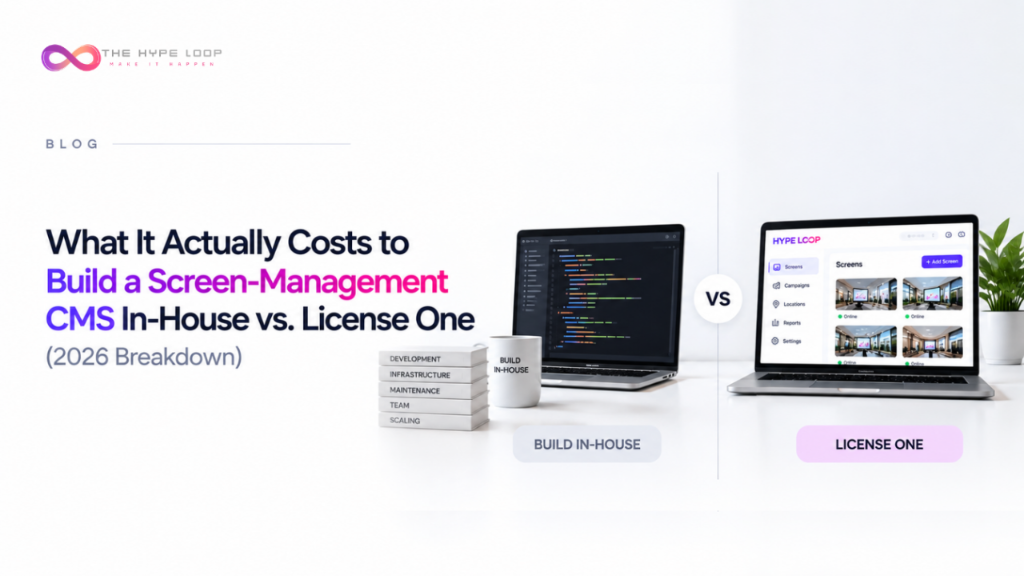
At some point, every media company, regional OOH operator, or property group managing more than a handful of screens has the exact same conversation: “Should we just build our own screen-management software instead of paying for an existing platform?”
It's a fair question — but one most leadership teams answer with gut optimism rather than a realistic engineering cost breakdown.
Building software looks simple on a whiteboard: a web dashboard, an upload button, and a player app. But keeping hundreds of remote screens synchronized, secure, and provably playing ads 24/7 is a brutal infrastructure discipline.
Here is the actual line-item cost breakdown of building a digital signage CMS in-house in 2026, compared to licensing a turnkey white-label platform like The Hype Loop.
The 7 Real Cost Pillars of Building a CMS In-House
A screen-management CMS isn't just a scheduling calendar — it's mission-critical distributed infrastructure. Here is what you are actually paying for:
Distributing high-definition video and image creatives to hundreds of screens across cities with minimal latency requires high-availability AWS/GCP edge CDN networks.
Storing gigabytes of raw video files, multi-resolution encodes, and millions of tamper-proof historical playback logs multiplied across screens and advertisers.
Screens constantly report heartbeats every 10–30 seconds, pull creative updates, and upload playback verification proofs, running up continuous network egress bills.
Screens experience intermittent Wi-Fi, power fluctuations, and OS crashes. Building background watchdog daemons that auto-heal and cache offline playlists takes months of specialized engineering.
You need backend engineers (Node/Go/Python), frontend web developers (React/Next), Android/Linux player firmware developers, and DevOps specialists — an ongoing monthly payroll of ₹3L–₹8L+.
OS updates, security vulnerability patches, screen owner support requests, and debugging why a player in a remote mall won't boot all fall squarely on your team.
The Development Timeline: What It Actually Takes
Building even an MVP of commercial screen-management software realistically follows a multi-quarter arc before a single display is reliably operating:
Phase 1: Basic Web Dashboard & Prototype Player
Building the web UI, basic login, and an initial media player app. It works nicely in office demos on high-speed fiber — but fails when deployed to field screens.
Phase 2: Firmware Crashes & Offline Caching Realities
Handling video decoder stutter, out-of-memory errors on cheap Android boxes, network dropouts, auto-boot on power restoration, and offline scheduling logic.
Phase 3: Tamper-Proof Proof-of-Play & Billing Reconciliation
Advertisers demand auditable logs proving their ad played at 3:14 PM on Screen #42. Building verifiable playback logs, invoicing automation, and tax compliance.
Phase 4: Eternal Technical Debt & Maintenance
Your business is now effectively a software company with perpetual bug backlogs, server patches, and firmware updates competing against your core sales goals.
Cost Comparison: Build In-House vs. License White-Label
| Evaluation Dimension | Building In-House | Licensing White-Label (The Hype Loop) |
|---|---|---|
| Initial Upfront CapEx | ₹15,00,000–₹35,00,000+ (Engineering team, UI/UX, QA) | ₹0 setup cost or minimal onboarding fee |
| Monthly Infrastructure & Maintenance | ₹3,00,000–₹6,00,000+ / mo (Cloud CDN, servers, salaries) | Predictable, per-screen or flat monthly license |
| Time to First Live Screen | 6 to 12 months minimum | Same day to 2 weeks |
| Hardware Compatibility | Must test & maintain every TV/OS chipset yourself | Pre-built, battle-tested players for Android, FireOS, Linux & web |
| Proof-of-Play Auditing | Complex cryptography & sync architecture required | Built-in tamper-proof logs with instant advertiser export |
| Branding & Client Ownership | Your brand | 100% white-label: your logo, your domain, your invoices |
How to Actually Decide: The Core Competency Test
Deciding whether to build or license boils down to a single honest strategic question:
“Is managing software infrastructure the core business you want to build, or is selling screen inventory and serving advertisers the business you want to scale?”
A media company whose greatest competitive advantage is prime venue contracts and advertiser trust is rarely best served by becoming an internal software development agency. Licensing a proven white-label engine lets you focus 100% of your energy on acquiring screens, signing clients, and growing profit margins.
Frequently Asked Questions
Can we migrate to our own CMS later if our network grows?
Yes. Starting with a white-label CMS gets you to market immediately while validating screen inventory revenue. If your network reaches thousands of screens and you eventually choose to build custom IP, you do so with proven revenue rather than speculative investment.
Can our advertisers book screen campaigns directly?
Yes! The Hype Loop white-label platform includes an optional self-serve booking layer where advertisers can browse your screens, select dates, upload creatives, and pay directly under your own branding.
What happens when a screen loses internet connectivity?
The player firmware automatically caches all scheduled playlists and creatives locally on the device. Ads continue playing seamlessly offline, and playback timestamps are uploaded the moment connectivity is restored.
How fast can we onboard our current screens onto The Hype Loop?
Existing screens running Android, FireTV, or mini PCs can typically be onboarded in minutes by pairing with a 6-digit screen code from your cloud admin dashboard.
Scale Your Screen Network on Proven Infrastructure
Skip the multi-quarter software development headaches. Launch your branded screen network with centralized scheduling, proof-of-play, and automated billing in days.